top of page
.png)
Quotes by Czechoslovakian Authors


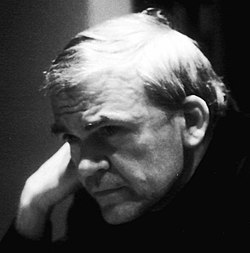
"Perhaps the reason we are unable to love is that we yearn to be loved, that is, we demand something (love) from our partner instead of delivering ourselves up to him demand-free and asking for nothing but his company."


"For it is clear immediately: human life as such is a defeat. All we can do in the face of that ineluctable defeat called life is to try to understand it. That - that is the raison d'Aatre of the art of the novel."
"They were ready to sell people a future in exchange for their past... They wanted to compel him to cast his life away and become a shadow, a man without past, an actor without a role, and turn even his castaway life, even the role the actor had abandoned, into a shadow. Having turned him into a shadow, they would let him live."
"You can understand nothing about art, particularly modern art, if you do not understand that imagination is a value in itself."
"Tell me, where in life is there a value that would make us consider suicide uncalled for on principle! Love? Or friendship? I guarantee that friendship is not a bit less fickle than love and it is impossible to build anything on it. Self-love? I wish it were possible."
"The longing for Paradise is man's longing not to be man."
"The termites of reduction have always gnawed away at life: even the greatest love ends up as a skeleton of feeble memories."
"Laughter was like an enormous trap waiting patiently in the room with them, but hidden behind a thin wall."
"Dreaming is not only an act of communication; it is also an aesthetic activity, a game of the imagination, a game that is a value in itself. Our dreams prove that to imagine - to dream about things that have not happened - is among mankind's deepest needs. Herein lies the danger. If dreams were beautiful, they would quickly be forgotten."
"A person's destiny often ends before his death."
"Metaphors are dangerous. Love begins with a metaphor. Which is to say, love begins at the point when a woman enters her first word into our poetic memory."
"People meet in the course of life, they talk together, they discuss, they quarrel, without realizing that they're talking to one another across a distance, each from an observation post standing in a different place in time."
"The assassination of Allende quickly covered over the memory of the Russian invasion of Bohemia, the bloody massacre in Bangladesh caused Allende to be forgotten, the din of war in the Sinai Desert drowned out the groans of Bangladesh, the massacres in Cambodia caused the Sinai to be forgotten, and so on, and on and on, until everyone has completely forgotten everything."
"Perhaps all the questions we ask of love, to measure, test, probe, and save it, have the additional effect of cutting it short. Perhaps the reason we are unable to love is that we yearn to be loved, that is, we demand something (love) from our partner instead of delivering ourselves up to him demand-free and asking for nothing but his company."
"Betrayal means breaking ranks and going off into the unknown. Sabina knew of nothing more magnificent than going off into the unknown."
"Yes, it was too late, and Sabina knew she would leave Paris, move on, and on again, because were she to die here they would cover her up with a stone, and in the mind of a woman for whom no place is home the thought of an end to all flight is unbearable."
"Never had she let herself go in this way with another body, and never had another body let itself go with her in this way. Her lover could play with her belly, but he had never lived in there; he could touch her breast, but he never drunk from it."
"For there is nothing heavier than compassion. Not even one's own pain weighs so heavy as the pain one feels with someone, for someone, a pain intensified by the imagination and prolonged by a hundred echoes."
"It takes a very great intelligence to breathe logical meaning into meaningless ideas."
"Brod was a brilliant intellectual with exceptional energy; a generous man willing to do battle for others; his attachment to Kafka was warm and disinterested. The only problem was his artistic orientation: a man of ideas, he knew nothing of the passion for form; his novels (he wrote twenty of them) are sadly conventional; and above all: he understood nothing at all about modern art.Why, despite all this, was Kafka so fond of him? What about you-do you stop being fond of your best friend because he has a compulsion to write bad verse?"
"(God) being the old man invented in order to, and with whom to, hold long conversations."
"He took her in his arms and lifted her up. She looked at him and he noticed only now that her eyes were full of tears. He pressed her to him. She understood that he loved her and this suddenly filled her with sadness. She felt sad that he loved her so much, and she felt like crying."
"I think I am a much better actor than I have allowed myself to be."
"Large countries' patriotism is different: they are buoyed by their glory, their importance, their universal mission. The Czechs loved their country not because it was glorious but because it was unknown; not because it was big but because it was small and in constant danger. Their patriotism was an enormous compassion for their country."
"Every situation is of man's making and can only contain what man contains."
"A meadow is nothing but a field of suffering. Every second some creature is dying in the gorgeous green expanse, ants eat wriggling earthworms, birds lurk in the sky to pounce on a weasel or a mouse. You see that black cat, standing motionless in the grass. She is only waiting for an opportunity to kill. I detest all that naA ve respect for nature. Do you think that a doe in the jaws of a tiger feels less horror than you? People thought up the idea that animals don't have the same capability for suffering as human, because otherwise they couldn't bear the knowledge that they are surrounded by a world of nature that is horror and nothing but horror."
"Indeed, the only truly serious questions are ones that even a child can formulate. Only the most naive of questions are truly serious. They are the questions with no answers. A question with no answer is a barrier that cannot be breached. In other words, it is questions with no answers that set the limit of human possibilities, describe the boundaries of human existence."
"Revolution in Love'. Can you tell me what you mean by that? Do you want free love as against bourgeois marriage, or monogamy as against bourgeois promiscuity?"
"The religion of orgasm: utilitarianism projected into sex life; efficiency versus indolence; coition reduced to an obstacle to be got past as quickly as possible in order to reach an ecstatic explosion, the only true goal of love-making and of the universe."
"For a novelist, a given historic situation is an anthropologic laboratory in which he explores his basic question: What is human existence?"
"They shout that they want to shape a better future, but it's not true. The future is only an indifferent void no one cares about,but the past is filled with life, and its countenance is irritating, repellent, wounding, to the point that we want to destroy it or repaint it. We want to be the masters of the future only for the power to change the past. We fight for access to the labs where we can retouch photos and rewrite biographies and history."
"Every novel says to the reader: "Things are not as simple as you think. That is the novel's eternal truth, but it grows steadily harder to hear amid the din of easy, quick answers that come faster than the question and block it off. In the spirit of our time, it's either Anna or Karenin who is right, and the ancient wisdom of Cervantes, telling us about the difficulty of knowing and the elusiveness of truth, seems cumbersome and useless."
"He took over anger to intimidate subordinates, and in time anger took over him."
"Today I know this: when it comes time to take stock, the most painful wound is that of broken friendships; and there is nothing more foolish than to sacrifice a friendship to politics."
"Certainty. Life's last and kindest gift."
"Optimism is the opium of the people."
"There is nothing heavier than compassion. Not even one's own pain weighs so heavy as the pain one feels for someone, for someone, pain intensified by the imagination and prolonged by a hundred echos."
"The uniform is that which we do not choose, that which is assigned to us; it is the certitude of the universal against the precariousness of the individual. When the values that were once so solid come under challenge and withdraw, heads bowed, he who cannot live without them (without fidelity, family, country, discipline, without love) buttons himself up in the universality of his uniform as if that uniform were the last shred of transcendence that could protect him against the cold of a future in which there will be nothing left to respect."
"Damn! What did Ansermet, that most faithful friend, know about Stravinsky's poverty of heart? What did he, that most devoted friend, know about Stravinsky's capacity to love? And where did he get his utter certainty that the heart is ethically superior to the brain? Are not vile acts committed as often with the heart's help as without it? Can't fanatics, with their bloody hands, boast of a high degree of "affective activity"? Will we ever be done with this imbecile sentimental Inquisition, the heart's Reign of Terror?"
"What we have not chosen we cannot consider either to our merit or our failure."
"There is no particular merit in being nice to one's fellow man... We can never establish with certainty what part of our relations with others is a result of our emotions — love, apathy, charity, or malice — and what part is predetermined by the constant power play among individuals. True human goodness, in all its purity and freedom, can come to the fore only when its recipient has no power. Mankind's true moral test, its fundamental test (which lies deeply buried from view), consists of its attitude towards those who are at its mercy: animals. And in this respect, mankind has suffered a fundamental débâcle — a débâcle so fundamental all others stem from it."
"He was no longer quite sure whether anything he had ever thought or felt was truly his own property, or whether his thoughts were merely a common part of the world's store of ideas which had always existed ready-made and which people only borrowed, like books from a library."
"Kitsch is the aesthetic ideal of all politicians and all political parties and movements. Those of us who live in a society where various political tendencies exist side by side and competing influences cancel or limit one another can manage more or less to escape the kitsch inquisition: the individual can preserve his individuality; the artist can create unusual works. But whenever a single political movement corners power, we find ourselves in the realm of totalitarian kitsch."
"Two people in love, alone, isolated from the world, that's beautiful."
"The stupidity of people comes from having an answer for everything. The wisdom of the novel comes from having a question for everything."
"I say, indeed: "consolation in the nonsentience of nature." For nonsentience is consoling; the world of nonsentience is the world outside human life; it is eternity; "it is the sea gone off with the sun" (Rimbaud)."
"She had experienced something beautiful, and he had failed to experience it with her. The two ways in which their memories reacted to the evening storm sharply delimit love and non-love."
"Jealousy has the amazing power to illuminate a single person in an intense beam of light, keeping the multitude of others in total darkness."
"Dogs are our link to Paradise. They don't know evil or jealousy or discontent. To sit with a dog on a hillside on a glorious afternoon is to be back in Eden, where doing nothing was not boring - it was peace."
"Horror is a shock, a time of utter blindness. Horror lacks every hint of beauty. All we can see is the piercing light of an unknown event awaiting us. Sadness, on the other hand, assumes we are in the know... The light of horror thus lost its harshness, and the world was bathed in a gentle, bluish light that actually beautified it."
bottom of page