top of page
.png)
Quotes by Czechoslovakian Authors


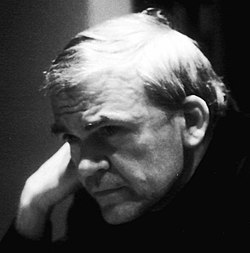
"All the same, a seductive voice from afar kept breaking into her conjugal peace: it was the voice of solitude. She closed her eyes and listened to the sound of a hunting horn coming from the depths of distant forests. There were paths in those forests."


"Do stories, apart from happening, being, have something to say? For all my skepticism, some trace of irrational superstition did survive in me, the strange conviction, for example, that everything in life that happens to me also has a sense, that it means something, that life speaks to us about itself through its story, that it gradually reveals a secret, that it takes the form of a rebus whose message must be deciphered, that the stories we live compromise the mythology of our lives and in that mythology lies the key to truth and mystery. Is it an illusion? Possibly, even probably, but I can't rid myself of the need continually to decipher my own life."
"The girl was grateful to the young man for every bit of flattery; she wanted to linger for a moment in its warmth and so she said, 'You're very good at lying.''Do I look like a liar?''You look like you enjoy lying to women,' said the girl, and into her words there crept unawares a touch of the old anxiety, because she really did believe that her young man enjoyed lying to women."
"The sound of laughter is like the vaulted dome of a temple of happiness."
"Happiness is the longing for repetition."
"How would I explain to him that I couldn't make peace with him? How would I explain that if I did I would immediately lose my inner balance? How would I explain that one of the arms of my internal scales would suddenly shoot upward? How would I explain that my hatred of him counterbalanced the weight of evil that had fallen on my youth? How would I explain that he embodied all the evils in my life? How would I explain to him that I needed to hate him?"
"There is a certain part of all of us that lives outside of time. Perhaps we become aware of our age only at exceptional moments and most of the time we are ageless."
"No peace is possible between the novelist and the agélaste [those who do not laugh]. Never having heard God's laughter, the agélastes are convinced that the truth is obvious, that all men necessarily think the same thing, and that they themselves are exactly what they think they are. But it is precisely in losing the certainty of truth and the unanimous agreement of others that man becomes an individual. The novel is the imaginary paradise of individuals. It is the territory where no one possesses the truth — neither Anna nor Karenin — but where everyone has the right to be understood, both Anna and Karenin."
bottom of page