top of page


Exlpore more Love quotes


"How'd you know he was the one?""I didn't know. I don't think either of us knew."Heather rolled her eyes. "Neal knew - he proposed to you.""It's not like that," Georgie said. "You'll see. It's more like you meet someone, and you fall in love, and you hope that that person is the one - and then at some point, you have to put down your chips. You just have to make a commitment and hope that you're right."
"When love is roaming in our mind, looping in the deepest fringes of our heart, undreamt spaciousness emerges, repealing the constraints of triviality and letting stifling narrowness fade away. While our mindset is besieged by a revolving burst of emotion, our world is ultimately opening up. ['Cape of good hope']"
"So you will meet many 'someones' who will give a new definition to your name. And you can not build walls, must not close the door and please don't hide,because if you ask me about hurt and loveI will say love. Love because the hurt will come and go no matter what, but only love makes it worth while. Only love can cure it. Don't be scared. Go. Love."
"Unconditional love goes beyond holding on and letting go. Real love is about truth. It's about looking at what's really going on instead of the stories we tell ourselves about it. It's about being able to love someone from afar, when we need to, because we see that closeness turns us into the worst versions of ourselves."
"Love and work... work and love, that's all there is."
Explore more quotes by Marcel Proust
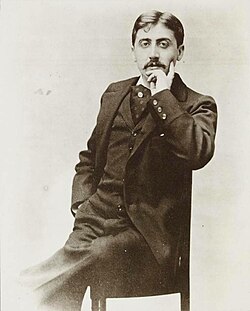
"We have such numerous interests in our lives that it is not uncommon, on a single occasion, for the foundations of a happiness that does not yet exist to be laid down alongside the intensification of a grief from which we are still suffering."
"In the case of the solitary, his seclusion, even when it is absolute and ends only with life itself, has often as its primary cause a disordered love of the crowd, which so far overruled every other feeling that, not being able to win, when he goes out, the admiration of his hall-porter, of the passers-by, of the cabman whom he hails, he prefers not to be seen by them at all, and with that object abandons every activity that would oblige him to go out of doors."
"I dined with Legrandin on the terrace of his house by moonlight. "There is a charming quality, is there not," he said to me, "in this silence; for hearts that are wounded, as mine is, a novelist whom you will read in time to come asserts that there is no remedy but silence and shadow. And you see this, my boy, there comes in all our lives a time, towards which you still have far to go, when the weary eyes can endure but one kind of light, the light which a fine evening like this prepares for us in the stillroom for darkness, when the ears can listen to no music save what the moonlight breathes through the flute of silence."
"In the sort of screen dappled with different states of mind which my consciousness would simultaneously unfold while I read, and which ranged from the aspirations hidden deepest within me to the completely exterior vision of the horizon which I had, at the bottom of the garden, before my eyes, what was first in me, innermost, the constantly moving handle that controlled the rest, was my belief in the philosophical richness and beauty of the book I was reading, and my desire to appropriate them for myself, whatever that book might be."
"Other people are, as a rule, so immaterial to us that, when we have entrusted to any one of them the power to cause so much suffering or happiness to ourselves, that person seems at once to belong to a different universe, is surrounded with poetry, makes of our lives a vast expanse, quick with sensation, on which that person and ourselves are ever more or less in contact."
"We enjoy lovely music, beautiful paintings, a thousand intellectual delicacies, but we have no idea of their cost, to those who invented them, in sleepless nights, tears, spasmodic laughter, rashes, asthmas, epilepsies, and the fear of death, which is worse than all the rest."
"... the burrowing wasp, which in order to provide a supply of fresh meat for her offspring after her own decease, calls in the science of anatomy to amplify the resources of her instinctive cruelty, and, having made a collection of weevils and spiders, proceeds with marvellous knowledge and skill to pierce the nerve-centre on which their power of locomotion (but none of their other vital functions) depends, so that the paralysed insect, beside which her egg is laid, will furnish the larva, when it is hatched, with a tamed and inoffensive quarry, incapable either of flight or of resistance, but perfectly fresh for the larder..."
bottom of page