top of page


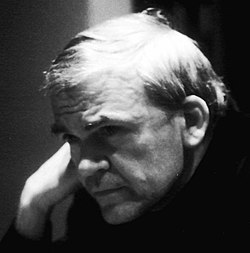
"Long ago one of the Cynic philosophers strutted through the streets of Athens in a torn mantle to make himself admired by everyone by displaying his contempt for convention. One day Socrates met him and said: 'I see your vanity through the hole in your mantle.' Your dirt too, sir, is vanity, and your vanity is dirty."
Standard
Customized

Exlpore more Vanity quotes

"Beauty is wasted on the self-absorbed."
"Even pearls are dark before the whiteness of his teeth."
"Visibility without Value is Vanity."
"An egotist is a person of low taste - more interested in himself than in me."
"They love their hair because they're not smart enough to love something more interesting."
Explore more quotes by Milan Kundera
"And she realized that she (her soul) was not at all involved, only her body, her body alone. The body that had betrayed her and that she had sent out into the world among other bodies."
"Between the approximation of the idea and the precision of reality there was a small gap of the unimaginable, and it was this hiatus that gave him no rest."
"Mankind's true moral test, its fundamental test (which lies deeply buried from view), consists of its attitude towards those who are at its mercy: animals. And in this respect mankind has suffered a fundamental debacle, a debacle so fundamental that all others stem from it."
"For what is love if one loves a woman without knowing her? Just a decision to love? Or even an imitation? The question concerns us all: If, from our childhood on, the examples of love were not there inviting us to copy them, would we know what "loving" means?"
"If excitement is a mechanism our Creator uses for His own amusement, love is something that belongs to us alone and enables us to flee the Creator. Love is our freedom. Love lies beyond "Es Muss sein!"
"How could she feel nostalgia when he was right in front of her? How can you suffer from the absence of a person who is present? You can suffer nostalgia in the presence of the beloved if you glimpse a future where the beloved is no more."
"And think about the precise meaning of that term: a Narcissus is not proud. A proud man has disdain for other people, he undervalues them. The Narcissus overvalues them, because in every person's eyes he sees his own image, and wants to embellish it. So he takes nice care of all his mirrors."
"A novel does not assert anything, a novel poses questions... The stupidity of people comes from having an answer for everything. When Don Quixote went out into the world, that world turned into a mystery before his eyes. That is the legacy of the first European novel to the entire subsequent history of the novel. The novelist teaches the reader to comprehend the world as a question. There is wisdom and tolerance in that attitude."
bottom of page