top of page


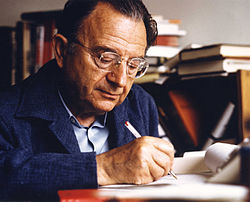
"When a person feels that he has not been able to make sense of his own life, he tries to make sense of it in terms of the life of his children. But one is bound to fail within oneself and for the children. The former because the problem of existence can be solved by each one only for himself, and not by proxy; the latter because one lacks in the very qualities which one needs to guide the children in their own search for an answer."
Standard
Customized

Exlpore more Family quotes

"Sometimes we're so concerned about giving our children what we never had growing up, we neglect to give them what we did have growing up."
"And like that, I said goodbye to my grandmother like we were two people who met in a coffee shop, shared a lifetime of stories and left wanting more, but knowing we'd meet there again."
"What thumbsuckers we all are...when it comes to mothers."
"Of course there are mothers,squeezing their breastsdry, pawning their bodies,shedding teeth for their children,or that's our fond belief.But remember - Hanseland Gretel were dumped in the forestbecause their parents were starving."
"We live in a world that has narrowed into a neighborhood before it has broadened into a brotherhood."
"Happy or unhappy, families are all mysterious. We have only to imagine how differently we would be described - and will be, after our deaths - by each of the family members who believe they know us."
Explore more quotes by Erich Fromm
"The task of the moral philosopher-thinker is to support and strengthen the voice of human conscience, to recognize what is good or what is bad for people, whether they are good or bad for society in a period of evolution. May be a "voice crying in the wilderness", but only if that voice remains lively and uncompromising, it is possible to transform the desert into fertile land."
"Modern man has transformed himself into a commodity; he experiences his life energy as an investment with which he should make the highest profit, considering his position and the situation on the personality market. He is alienated from himself, from his fellow men and from nature. His main aim is profitable exchange of his skills, knowledge, and of himself, his "personality package" with others who are equally intent on a fair and profitable exchange. Life has no goal except the one to move, no principle except the one of fair exchange, no satisfaction except the one to consume.p97."
"That millions of people share the same forms of mental pathology does not make these people sane."
"The more man gains freedom in the sense of emerging from the original oneness with man and nature and the more he becomes an 'individual,' he has no choice but to unite himself with the world in the spontaneity of love and productive work or else to seek a kind of security by such ties with the world that destroys his freedom and the integrity of his individual self."
"Psychology as a science has its limitations, and, as the logical consequence of theology is mysticism, so the ultimate consequence of psychology is love."
"We live in a world of things, and our only connection with them is that we know how to manipulate or to consume them."
"To have faith requires courage, the ability to take a risk, the readiness even to accept pain and disappointment. Whoever insists on safety and security as primary conditions of life cannot have faith; whoever shuts himself off in a system of defense, where distance and possession are his means of security, makes himself a prisoner. To be loved, and to love, need courage, the courage to judge certain values as of ultimate concern " and to take the jump and to stake everything on these values."
"It is the task of the "science of man" to arrive eventually at a correct description of what deserves to be called human nature. What has often been called "human nature" is but one of its many manifestations - and often a pathological one - and the function of such mistaken definition usually has been to defend a particular type of society as being the necessary one."
"What kind of men, then, does our society need? What is the "social character" suited to twentieth century Capitalism? It needs men who co-operate smoothly in large groups; who want to consume more and more, and whose tasks are standardized and can easily be influenced and anticipated. It needs men who feel free and independent, not subject to any authority, or principle, or conscience - yet willing to be commanded, to do what is expected, to fit into the social machine without friction."
bottom of page