top of page


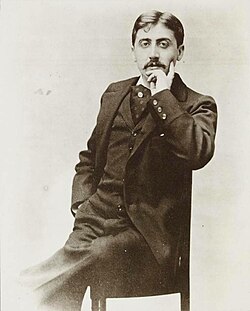
"What we have not had to decipher, to elucidate by our own efforts, what was clear before we looked at it, is not ours. From ourselves comes only that which we drag forth from the obscurity which lies within us, that which to others is unknown."
Standard
Customized

Exlpore more Learning quotes

"As long as you live, keep learning how to live."
"The mind unlearns with difficulty what it has long learned."
"To learn how to swim, observe fish; how to hunt, observe lions; how to work, observe bees, and how to live, observe sages."
"The most important thing about the quest for knowledge is that it should never end."
"All approaches to a study or an individual may start with a desire for attention. However they start, they must never end up in this manner."
"It's fine to celebrate success but it is more important to heed the lessons of failure."
"The complexity of our present trouble suggests as never before that we need to change our present concept of education. Education is not properly an industry, and its proper use is not to serve industries, either by job-training or by industry-subsidized research. It's proper use is to enable citizens to live lives that are economically, politically, socially, and culturally responsible. This cannot be done by gathering or "accessing" what we now call "information" - which is to say facts without context and therefore without priority. A proper education enables young people to put their lives in order, which means knowing what things are more important than other things; it means putting first things first."
"This sort of information gathering is precisely what we call play. And the important function of play is thus revealed: it permits us to gain, without any particular future application in mind, a holistic understanding of the world, which is both a complement of and a preparation for later analytical activities."
Explore more quotes by Marcel Proust
"But sometimes it is just when everything seems to be lost that we experience a presentiment that may save us; one has knocked on all the doors which lead nowhere, and then, unwittingly, one pushes against the only one through which one may enter and for which one would have searched in vain for a hundred years, and it opens."
"We have such numerous interests in our lives that it is not uncommon, on a single occasion, for the foundations of a happiness that does not yet exist to be laid down alongside the intensification of a grief from which we are still suffering."
"In the case of the solitary, his seclusion, even when it is absolute and ends only with life itself, has often as its primary cause a disordered love of the crowd, which so far overruled every other feeling that, not being able to win, when he goes out, the admiration of his hall-porter, of the passers-by, of the cabman whom he hails, he prefers not to be seen by them at all, and with that object abandons every activity that would oblige him to go out of doors."
"I dined with Legrandin on the terrace of his house by moonlight. "There is a charming quality, is there not," he said to me, "in this silence; for hearts that are wounded, as mine is, a novelist whom you will read in time to come asserts that there is no remedy but silence and shadow. And you see this, my boy, there comes in all our lives a time, towards which you still have far to go, when the weary eyes can endure but one kind of light, the light which a fine evening like this prepares for us in the stillroom for darkness, when the ears can listen to no music save what the moonlight breathes through the flute of silence."
"On no days of our childhood did we live so fully perhaps as those we thought we had left behind without living them, those that we spent with a favourite book."
"Much that for us is fraught with with happiness or misery, remains almost unnoticed by the rest of the world."
"But since the facts which I should then have recalled would have been prompted only by an exercise of the will, by my intellectual memory, and since the pictures which that kind of memory shews us of the past preserve nothing of the past itself, I should never have had any wish to ponder over this residue of Combray."
bottom of page