.png)
Galileo Galilei: The Scientific Spirit That Could Not Be Silenced

In the quiet streets of Pisa, Italy, on February 15, 1564, a child was born who would shake the foundations of human understanding and forever change how we view our place in the universe. Galileo Galilei, born to a musician and composer, would grow up to become not just a scientist, but a symbol of the eternal struggle between truth and authority, between what is known and what dares to be discovered.
The young Galileo showed an insatiable curiosity that would define his life. As a child, he wasn't content with simply playing with toys – he wanted to understand how they worked. His father, Vincenzo Galilei, a renowned musician and music theorist, had inadvertently planted the seeds of scientific inquiry in his son's mind by questioning traditional musical theories. This early exposure to questioning established wisdom would shape Galileo's entire approach to understanding the world.
Initially following his father's wishes, Galileo began studying medicine at the University of Pisa in 1580. However, his true passion lay elsewhere. Legend has it that while sitting in the Pisa Cathedral, he observed a swinging lamp and noticed something remarkable – regardless of how wide the lamp swung, it seemed to take the same amount of time to complete each swing. Using his pulse to time the oscillations, he discovered what would later be known as the principle of isochronism, which would eventually lead to the development of pendulum clocks.
This observation marked the beginning of Galileo's real scientific journey. He left medicine behind and devoted himself to mathematics and natural philosophy. By the age of 25, in 1589, he had secured a position as chair of mathematics at the University of Pisa. It was here that he would begin his famous experiments with falling objects, challenging Aristotle's long-accepted notion that heavier objects fall faster than lighter ones.
The popular story of Galileo dropping balls from the Leaning Tower of Pisa, while debated by historians, captures the essence of his revolutionary approach to science. Rather than simply accepting the teachings of ancient authorities, he insisted on testing ideas through observation and experiment. This method – what we now call the scientific method – was perhaps his greatest contribution to human knowledge.

In 1592, Galileo moved to the University of Padua, where he would spend the next 18 years in what he later called the happiest years of his life. During this period, he made several groundbreaking inventions and discoveries:
• In 1593, he invented the thermoscope, a precursor to the thermometer
• In 1596, he invented a military compass used for artillery calculations
• In 1609, after hearing about Dutch spectacle-makers creating a device that made distant objects appear closer, he developed his own improved version of the telescope
The telescope would prove to be the instrument that both made his fame and eventually led to his downfall. In 1609, Galileo turned his improved telescope toward the heavens, becoming the first person to use the instrument for systematic astronomical observation. What he saw would change everything:
• He discovered four moons orbiting Jupiter, proving that not all celestial bodies revolved around Earth
• He observed the phases of Venus, similar to the phases of the Moon
• He saw that the Moon's surface was rough and mountainous, not perfectly smooth as previously believed
• He observed countless stars invisible to the naked eye
• He discovered sunspots, showing that the Sun was not perfect and unchanging
These observations led Galileo to support the Copernican theory that the Earth and other planets orbit around the Sun, rather than everything orbiting around the Earth as was commonly believed. This conclusion would put him on a collision course with the Catholic Church.
In 1616, the Church declared the Copernican theory heretical and Galileo was warned to abandon his support for it. For several years, he complied, but in 1632, he published "Dialogue Concerning the Two Chief World Systems", a work that, while technically presenting both the Copernican and traditional views, clearly favoured the Copernican system.
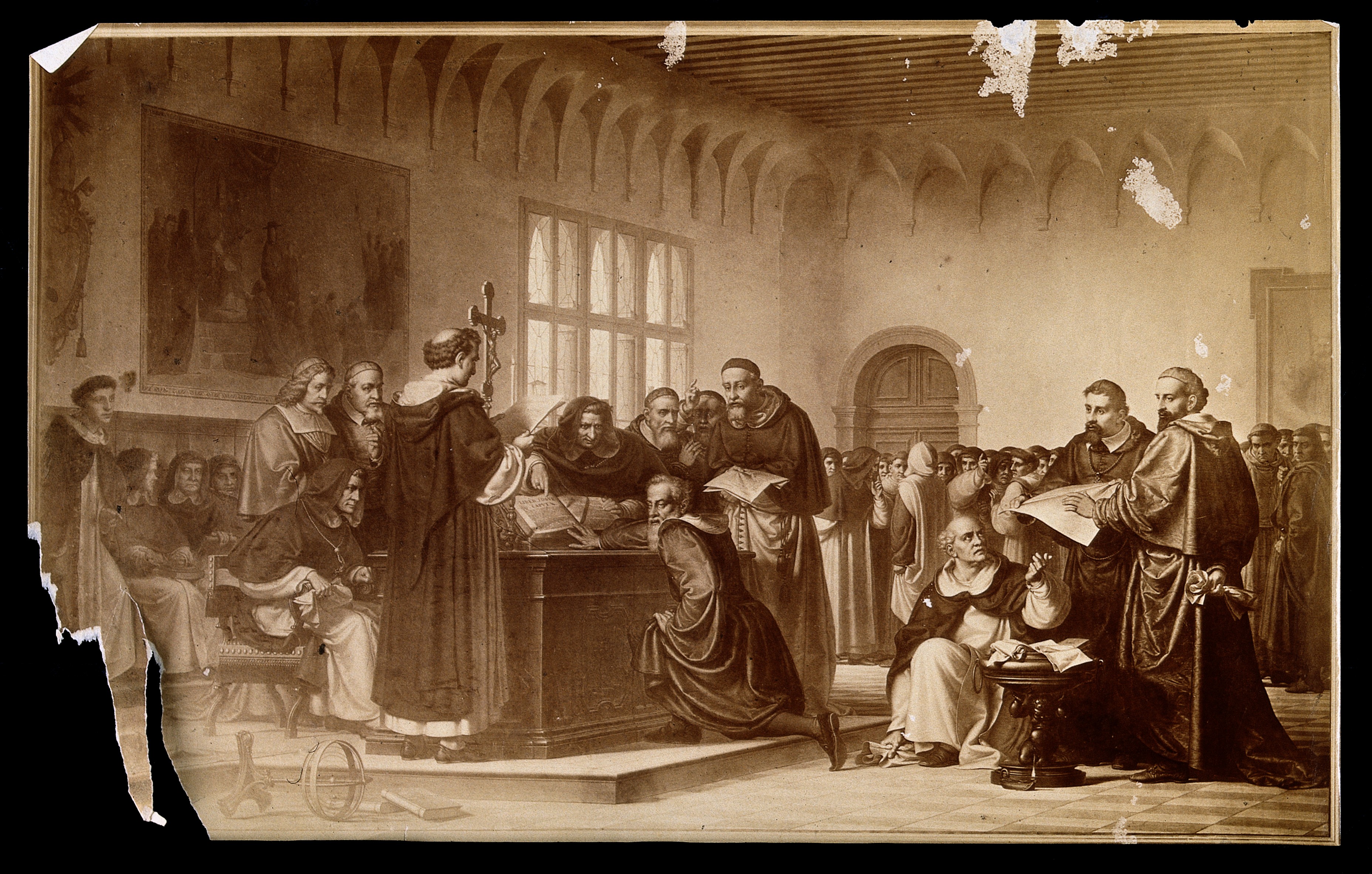
The publication led to Galileo's most famous confrontation with authority. In 1633, at the age of 69, he was summoned to Rome to face the Inquisition. Despite his advanced age and declining health, he was forced to make the journey in the middle of winter. The trial that followed would become a symbol of the conflict between science and dogma.

Under threat of torture and facing possible execution, Galileo was forced to publicly recant his support for the Copernican theory. Legend has it that after formally denying that the Earth moves around the Sun, he muttered under his breath, "And yet it moves" (Eppur si muove). While this story is likely apocryphal, it captures the spirit of scientific truth persisting even in the face of oppression.
Galileo spent the remaining years of his life under house arrest at his villa in Arcetri, near Florence. Despite being prohibited from publishing and receiving visitors, he continued his scientific work. During this period, he wrote "Two New Sciences", which laid the groundwork for modern physics and engineering. Even after becoming completely blind in 1638, he continued to work with his assistants, including his devoted daughter Sister Maria Celeste.
When Galileo died on January 8, 1642, he left behind a legacy that extended far beyond his scientific discoveries. His real triumph was in establishing a new way of understanding the natural world – one based on observation, experiment and mathematical analysis rather than philosophical speculation or religious authority.
The significance of Galileo's contributions cannot be overstated:
• He helped establish the scientific method as we know it today
• His astronomical discoveries provided the first observational evidence for the Copernican system
• His work in physics laid the foundation for Newton's laws of motion
• His insistence on mathematical description of natural phenomena revolutionized scientific thinking
• His courage in defending scientific truth in the face of institutional opposition set an example that still inspires today
In 1992, 350 years after his death, Pope John Paul II formally apologized for the Church's treatment of Galileo, acknowledging the error of his condemnation. This act symbolically ended one of history's most famous conflicts between science and religious authority.
Today, Galileo stands as more than just a brilliant scientist – he represents the triumph of reason over dogma, of observation over assumption and of courage over conformity. His life teaches us that the pursuit of truth sometimes requires us to stand alone, to challenge accepted wisdom and to face powerful opposition with unwavering conviction.
The stars that Galileo studied so carefully continue to shine and humanity's understanding of the universe continues to expand along the path he helped forge. His story reminds us that progress often comes at a price, but that the advancement of human knowledge is worth the struggle. In the end, the truth does move forward, just as Galileo knew the Earth moves around the Sun.
As we face our own modern challenges and scientific controversies, Galileo's example remains relevant and inspiring. His life shows us that the pursuit of truth, while sometimes difficult and dangerous, is one of humanity's noblest endeavours. In his courage to question, his dedication to evidence and his persistence in the face of opposition, we find a model for how to approach our own search for understanding in an ever-complex world.
If you found inspiration in Galileo's remarkable journey of discovery and courage, please share this article with others who might be moved by his story. His legacy reminds us that one person's pursuit of truth can change the world forever. Like, comment and share to spread the message of perseverance, scientific inquiry and unwavering dedication to truth that Galileo embodied. Your thoughts and perspectives on his incredible life story are welcome in the comments below. Together, let's keep the spirit of discovery alive!