.png)
Adam Neumann: From WeWork’s Rise and Fall to Flow’s Ambitious Comeback

The boy who would become one of the most polarizing figures in modern business began his life on the move. Born in 1979 in Israel — sources vary between Beersheba and Tel Aviv — the man known as Adam Neumann spent his childhood in a state of constant transition. By the time he turned twenty‑two he had lived in thirteen different homes. His parents divorced when he was seven, fracturing what stability a young life might have held. With his mother (his father was also in medical training), Neumann spent part of his early childhood in the United States, during which he struggled with severe dyslexia — he could neither read nor write until third grade. As a boy uprooted from one place to another, he learned to navigate the world through observation, charm, and a growing sense that persuasion might outweigh conventional schooling.
When his family returned to Israel, they settled on a kibbutz in the south — Kibbutz Nir Am, a communal settlement located near the Gaza‑border region. As a teenager, Neumann lived on the kibbutz, where daily life revolved around communal responsibility and shared living — everyone contributed, everyone belonged. For a boy accustomed to constant change and little permanence, the kibbutz offered something different: the idea of being part of a collective, of belonging to a community. He later said he loved how people on the kibbutz shared meals and everyday routines, and that those years shaped his view of community and collaboration. Years later, when pitching investors on his vision for WeWork, he would frequently reference those formative days — speaking of togetherness, meaning beyond material goods, and building communities rather than just companies.
But Neumann wasn’t content to remain on the kibbutz. After high school he enlisted in the Israeli Navy and served for five years. By his early twenties, he was eager for something more. In 2001 he moved to New York City, arriving with modest means but big aspirations. He enrolled at Baruch College to study business, yet found the traditional classroom less compelling than the opportunities he saw around him — convinced that real lessons lay not in lectures, but in doing.
His first ventures were modest failures. He tried selling women’s shoes with a retractable heel — a concept that never took off. Next, he launched a baby‑clothing line called Krawlers, with built‑in kneepads for crawling infants. He has acknowledged borrowing money from his sister (and other backers) to fund these ventures, but the business struggled. Eventually, he gave up on both. Far from being just about products or profits, what he began to grasp in those years was a different kind of leverage: how powerful storytelling and vision could be. He realized that a compelling narrative — one that made people want to buy in, or belong — could turn simple ideas into something bigger.
In 2008, he met Miguel McKelvey — an architect — and the two quickly bonded over their shared dissatisfaction with conventional offices. That year they co‑founded Green Desk, an eco‑friendly coworking space in Brooklyn: leased floors subdivided into small offices and desks furnished with recycled materials, powered by wind and stocked with shared amenities. Their approach combined flexibility, community, and sustainability. Green Desk picked up momentum, but by 2010 Neumann and McKelvey decided to sell their stake to their landlord, receiving modest payouts. Meanwhile, backed by a US$15 million investment from real‑estate developer Joel Schreiber, they launched a new venture — WeWork. Building on the coworking idea but aiming for far greater scale, they envisioned a network of shared workspaces under their own brand.
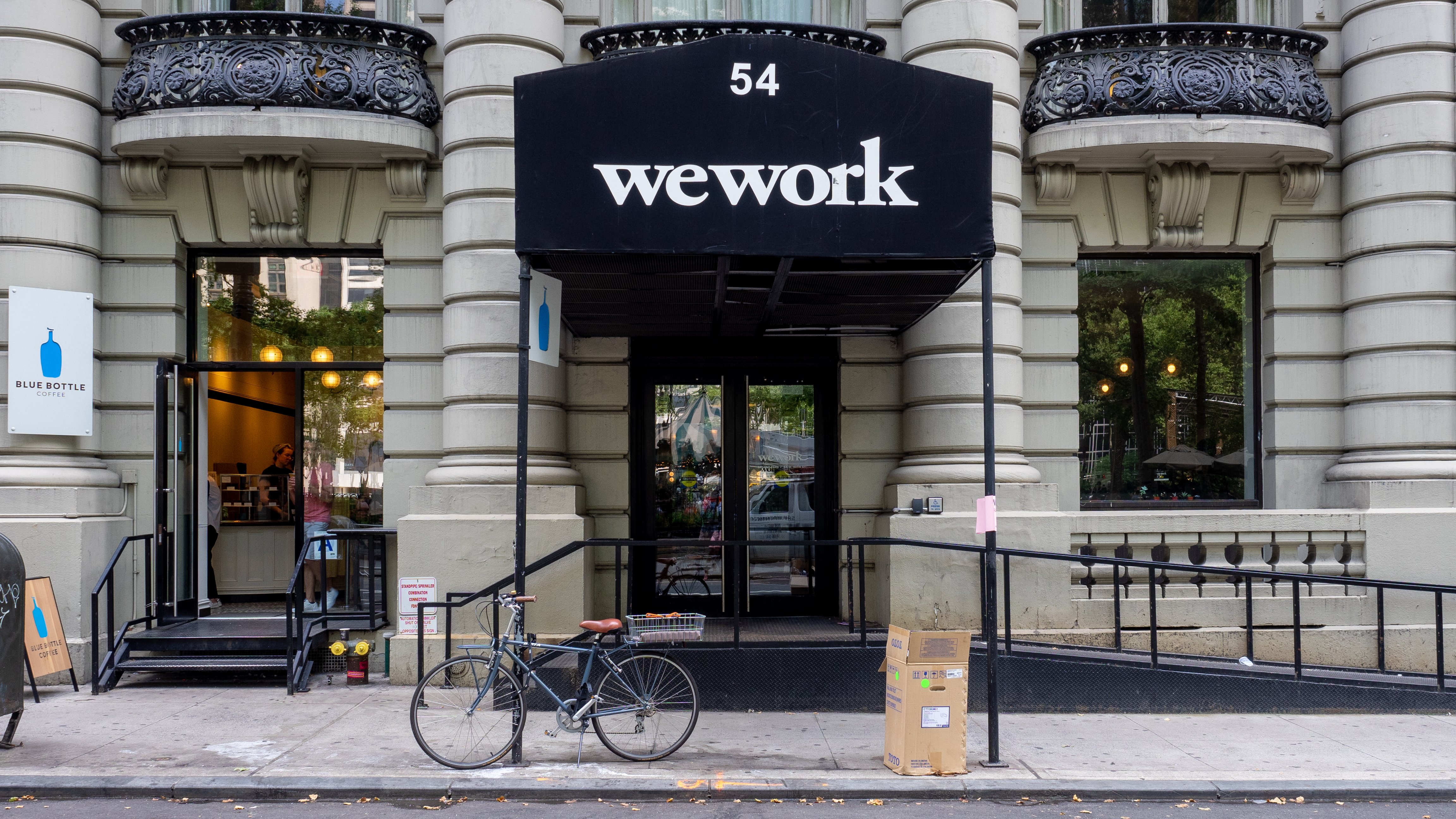
In 2010, WeWork was born.
From a single location in Manhattan’s SoHo neighbourhood, the company set out to redefine office space. More than just desks and cubicles, WeWork aimed to offer flexible, shared workspaces designed for freelancers, startups, and small companies — combining functional office amenities with a sense of community and modern aesthetics. In the wake of the financial crisis, when many traditional office leases felt restrictive or risky, WeWork offered an alternative: shorter-term commitments, collaborative environments, and a setting that appealed to a generation seeking flexibility and connection. The appeal went beyond just real estate — for many, it was about belonging, collaboration, and a new way of working.
Neumann cut a striking figure — tall, with dark, wavy hair often falling past his ears, dressed casually — a far cry from the buttoned‑up CEOs of old. In investor rooms or company gatherings, he exuded a kind of magnetism: confident, energetic, often speaking with a fervour that made listeners lean forward. He rarely talked about leases or square footage; instead, he spoke of community, connection, and a new vision of work — of building a place where people could craft a life, not just a living. He frequently referenced his childhood on a kibbutz, framing the ethos of WeWork as a modern re‑imagining of communal values — combining belonging with ambition. It was bold, idealistic, and for many, deeply compelling.
The business exploded. By 2014, WeWork was already being called the fastest‑growing lessee of new office space in New York. Over the next few years, the company expanded worldwide, opening hundreds of locations across dozens of cities. Investors poured billions into WeWork, drawn by Neumann’s bold vision of a shared‑space future. The biggest backer was SoftBank, whose funding rounds helped swell WeWork’s private valuation to roughly US$ 47 billion by early 2019.
But beneath the surface, cracks had begun to show. Neumann’s leadership style raised eyebrows. Reports described a company culture that indulged in expensive perks and a free‑wheeling lifestyle — a corporate jet, lavish amenities, and a party‑friendly atmosphere that blurred the boundary between work and revelry. He carried out deals that sparked corporate‑governance concerns: some buildings leased by WeWork were partially owned by companies tied to him, and he once sold the trademark for the word “We” to WeWork — receiving roughly US$ 5.9 million — a move widely criticized before he returned the payment. Meanwhile, he used his stock and shares as collateral for personal loans to fund assets and real‑estate holdings.
At the same time, Neumann’s ambitions grew both more visionary and more controversial. He spoke publicly of becoming the world’s first trillionaire and reportedly imagined grand expansions for WeWork — even beyond Earth. He and his wife embraced Kabbalah, a mystical form of Judaism, and Neumann was known to wear a red‑string bracelet as a symbol of that spiritual path. The language of energy, consciousness, and communal uplift seeped into WeWork’s public image. In its IPO filing, the company declared its goal was “to elevate the world’s consciousness” — an ideal that for many read less like a business mission and more like a spiritual manifesto.
In August 2019, WeWork filed its S‑1 prospectus. The document exposed what had long been hidden behind funding rounds and charisma: the company was losing large amounts of money — in 2018 alone, net losses soared to roughly US$1.6 billion. Its business model — locking in long‑term real estate leases and subletting short‑term coworking memberships — revealed an inherent mismatch of obligations versus revenues, raising serious doubts about sustainability. The filing also laid bare serious governance issues: Neumann and his wife held special multi‑vote shares, giving them outsized control over corporate decisions, even as financial and strategic risks mounted.

Investor confidence evaporated quickly. What once seemed like a US $47 billion company saw its valuation collapse — by mid‑September 2019 expectations had dropped to around US $20 billion, and soon after to roughly US $10 billion. Under pressure from SoftBank and other key backers, WeWork’s board forced Adam Neumann to step down as CEO on September 24, 2019. Within days, the company withdrew its IPO filing. The startup that once promised to “change the world” failed even to reach Wall Street.
The fallout was swift and painful. WeWork laid off thousands of employees — at least 2,400 globally — as the company scrambled to stay afloat. Many investors lost large sums, their stakes shrinking dramatically as valuations collapsed. Neumann, meanwhile, walked away with a controversial exit deal: cash, stock sales, refinancing of loans, and other compensation that in some estimates amounted to as much as US $1.7 billion. For many, it was infuriating — a founder freed from failure while those who stayed behind bore the losses. Supporters, however, argued he was being unfairly scapegoated, and that the collapse reflected broader systemic failures in the startup and venture capital model rather than just one individual’s missteps.
For many entrepreneurs, such a public implosion would mark the end of the story. For Adam Neumann, it was merely an intermission.
By 2022, three years after his exit from WeWork, Adam Neumann founded Flow — a residential real‑estate company aimed at rethinking apartment living. In August of that year, venture‑capital firm Andreessen Horowitz invested about US $350 million in the startup — the largest single‑round check the firm had ever written. That funding gave Flow a private valuation of over US $1 billion, even before significant operations began. In public communications, the backers described Flow’s goal as offering community‑oriented rentals and reimagining how people live, positioning it as an attempt to address challenges in the housing and rental market.
Flow is a community‑driven residential startup. Neumann said tenants would “feel ownership” of their apartments and used a toilet‑plunger metaphor to illustrate the concept. He also described plans to share some portion of value with residents, though details on actual equity or implementation have not been disclosed. The venture emphasizes technology‑enabled living and fostering community among renters.
Critics were sceptical. After his high‑profile failure at WeWork, many questioned whether Neumann could be trusted with another large real‑estate venture. Flow claims to operate differently than WeWork: rather than leasing properties and re‑subleasing, Flow acquires and directly manages apartment buildings. As of 2025, Flow reportedly owns more than 3,000 units across several U.S. states. In April 2025, Flow closed a funding round of over US $100 million that brought its valuation to approximately US $2.5 billion — more than double its 2022 valuation.
Flow expanded beyond the U.S. in 2024, launching its first international property in Riyadh, Saudi Arabia. The initial Saudi compound includes 238 furnished apartments. Meanwhile, Flow continues to own and operate residential properties in the United States.
From his childhood on a kibbutz to co-founding WeWork, and from leading a company valued at nearly forty-seven billion dollars to stepping down amid financial collapse, Adam Neumann has continuously pursued ambitious visions. Despite setbacks, he launched Flow, a residential real estate company that has raised hundreds of millions in funding and expanded internationally, including into Saudi Arabia. His journey shows that reinvention is possible, and that bold ideas, even after failure, can find new opportunities to shape industries and communities.

Adam Neumann co-founded WeWork, which grew into a company valued at nearly forty-seven billion dollars and attracted billions in investment. He led thousands of employees and made decisions that contributed to both rapid growth and financial instability. After leaving WeWork, he launched Flow, a residential real-estate company, continuing to pursue ambitious ventures despite past setbacks.
Perhaps the most notable aspect of Neumann’s story is his continued return to ambitious ventures. After leaving WeWork, he launched Flow, a residential real-estate company backed by prominent investors including Andreessen Horowitz. The company emphasizes community-oriented living spaces and aims to create environments where residents can connect and engage, reflecting principles Neumann has consistently highlighted in his public statements.
The future of Adam Neumann’s career remains uncertain. Flow, his residential real-estate company, has received significant funding, expanded internationally, and continues to grow its portfolio of properties in the United States. Observers note that Neumann’s ventures reflect the challenges and opportunities of modern entrepreneurship, where leadership, vision, and strategy intersect in complex ways, and where outcomes can shift rapidly in response to market realities.
For now, Adam Neumann remains what he has always been: a risk-taker, a dreamer, and a man in perpetual motion. From the deserts of Israel to the skyscrapers of New York, from the heights of Silicon Valley to the wreckage of a failed IPO, he has never stopped building, never stopped selling, never stopped believing that the next venture will be the one that changes everything. And in a world hungry for bold ideas and transformative leaders, that might be the most dangerous—and the most powerful—quality of all.
If you found Adam Neumann’s journey as fascinating and thought-provoking as we did, don’t keep it to yourself! Like, comment, and share this story to spark conversation about ambition, resilience, and the lessons of modern entrepreneurship.