top of page
.png)

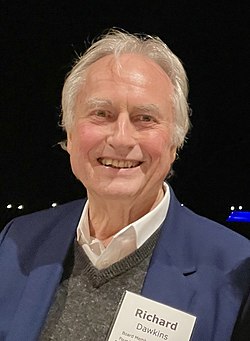
"Science has taught us, against all intuition, that apparently solid things like crystals and rocks are really almost entirely composed of empty space. And the familiar illustration is the nucleus of an atom is a fly in the middle of a sports stadium, and the next atom is in the next sports stadium."
Standard
Customized

Exlpore more Science quotes

"Time in itself, absolutely, does not exist; it is always relative to some observer or some object. Without a clock I say 'I do not know the time' . Without matter time itself is unknowable. Time is a function of matter; and matter therefore is the clock that makes infinity real."
"I don't think there's an interesting boundary between philosophy and science. Science is totally beholden to philosophy. There are philosophical assumptions in science and there's no way to get around that."
"Much more plausible is the computer-based explanation that dreams are a spillover from the unconscious processing of the day's experience, from the brain's decision on how much of the daily events temporarily stored in a kind of buffer to emplace in long-term memory... The American psychiatrist Ernest Hartmann of Tufts University has providedanecdotal but reasonably persuasive evidence that people who are engaged in intellectual activities during the day, especially unfamiliar intellectual activities, require more sleep at night, while, by and large, those engaged in mainly repetitive and intellectually unchallenging tasks are able to do with much less sleep."
"Dark Energy is poorly understood and it is clear that we are currently moving into exploring thecomplete electromagnetic spectrum that also includes the study of atmospheric pressure waves,atmospheric voltage effects on the cellular system, and the biological effects of the various forms ofatmospheric radiation transmission."
Explore more quotes by Richard Dawkins
"Personally, I rather look forward to a computer program winning the world chess championship. Humanity needs a lesson in humility."
"We wanted to be accepted by our fellows, especially the influential natural leaders among us; and the ethos of my peers was " until my last year at Oundle " anti-intellectual. You had to pretend to be working less hard than you actually were. Native ability was respected; hard work was not. It was the same on the sports field. Sportsmen were admired more than scholars in any case. But if you could achieve sporting brilliance without training, so much the better. Why is native ability more admired than hard graft? Shouldn't it be the other way around?"
"Why would an all-powerful creator decide to plant his carefully crafted species on islands and continents in exactly the appropriate pattern to suggest, irresistibly, that they had evolved and dispersed from the site of their evolution?"
"Isaac Asimov's remark about the infantilism of pseudoscience is just as applicable to religion: 'Inspect every piece of pseudoscience and you will find a security blanket, a thumb to suck, a skirt to hold.' It is astonishing, moreover, how many people are unable to understand that 'X is comforting' does not imply 'X is true'."
"Problems arise when (especially) theologians use such metaphorical language without realizing that that is what they are doing, and without even realizing that there is a distinction between metaphor and reality " saying something like: 'It is not important whether Jesus really fed the five thousand. What matters is what the idea of the story means to us.' Actually it is important, because millions of devout people do believe the Bible is literally true."
"When I say that human beings are just gene machines, one shouldn't put too much emphasis on the word 'just.' There is a very great deal of complication, and indeed beauty in being a gene machine."
"Individuals are not stable things, they are fleeting. Chromosomes too are shuffled into oblivion, like hands of cards soon after they are dealt. But the cards themselves survive the shuffling. The cards are the genes. The genes are not destroyed by crossing-over, they merely change partners and march on. Of course they march on. That is their business. They are the replicators and we are their survival machines. When we have served our purpose we are cast aside. But genes are denizens of geological time: genes are forever."
bottom of page