top of page
.png)

Exlpore more Astronomy quotes


"We are probably nearing the limit of all we can know about astronomy."
"My amateur interest in astronomy brought out the term 'magnitude,' which is used for the brightness of a star."
"But when researchers at Bell Labs discovered that static tends to come from particular places in the sky, the whole field of radio astronomy opened up."
"Did you say the stars were worlds, Tess?""Yes.""All like ours?""I don't know, but I think so. They sometimes seem to be like the apples on our stubbard-tree. Most of them splendid and sound - a few blighted.""Which do we live on - a splendid one or a blighted one?""A blighted one."
"This is very similar to astronomy where different magnitudes are assigned to the brightness of an astronomical object, depending on the range of wavelengths being measured."
"Stars are fires that burn for thousands of years. Some of them burn slow and long, like red dwarfs. Others-blue giants-burn their fuel so fast they shine across great distances, and are easy to see. As they start to run out of fuel, they burn helium, grow even hotter, and explode in a supernova. Supernovas, they're brighter than the brightest galaxies. They die, but everyone watches them go."
"This sight... is by far the noblest astronomy affords."
"Until very recently, the heavenly bodies have been investigated only with reference to their position and their laws of motion, and a quarter of a century ago astronomy was little more than celestial topography."
Explore more quotes by Carl Sagan
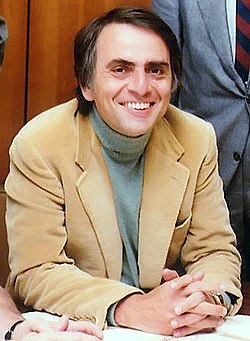
"Religions are often state-protected nurseries of pseudoscience, although there's no reason why religions have to play that role. In a way, it's an artefact from times long gone."
"I am often amazed at how much more capability and enthusiasm for science there is among elementary school youngsters than among college students."
"When we look up at night and view the stars, everything we see is shinning because of distant nuclear fusion."
"Pliny suggested that the ostrich, then newly discovered, was the result of a cross between a giraffe and a gnat. (It would, I suppose, have to be a female giraffe and a male gnat.) In practice there must be many such crosses which have not beenattempted because of a certain understandable lack of motivation."
"I consider it an extremely dangerous doctrine, because the more likely we are to assume that the solution comes from the outside, the less likely we are to solve our problems ourselves."
"Billions of years from now our sun, then a distended red giant star, will have reduced Earth to a charred cinder. But the Voyager record will still be largely intact, in some other remote region of the Milky Way galaxy, preserving a murmur of an ancient civilization that once flourished - perhaps before moving on to greater deeds and other worlds - on the distant planet Earth."
"I do not think it irresponsible to portray even the direst futures if we are to avoid them we must understand that they are possible. But where are the alternatives Where are the dreams that motivate and inspire We long for realistic maps of a world we can be proud to give to our children. Where are the cartographers of human purpose Where are the visions of hopeful futures of technology as a tool for human betterment and not a gun on hair trigger pointed at our heads."
bottom of page