top of page


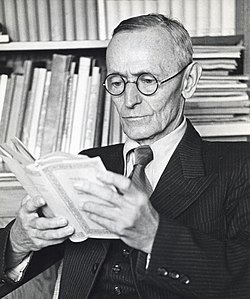
"An enlightened man had but one duty - to seek the way to himself, to reach inner certainty, to grope his way forward, no matter where it led."
Standard
Customized

Exlpore more Enlightenment quotes

"Follow the path that leads to understanding. Only then, will you illuminate the way for others. Once you open your mind and gain knowledge, truth, you'll leave the darkness and enter into the light of wisdom."
"Enlightenment is tuning our consciousness to music of the universe."
"The people who enlighten us are the ones who tell us their secrets."
"The one who becomes free from all kinds of beggary is bestowed the state of a 'Gnani' [the enlightened one]."
"Light is what we are called to preach. Our lord and saviour called himself light of the world."
"We' (the Gnani Purush, the enlightened one) are by nature, non-interfering. If 'we', ourselves are non-interfering, then how can interfering people around 'us' can touch 'us'? All interferences go away in 'our' [the Gnani's] presence. What problems can the one that dwells in the Self [the Soul], have? The worldly life does not hinder the one who dwells in the Self."
"The worldly [spiritual] science is methodic (kramic) in nature; one progresses "step by step; one has to ascent one step at a time. Whereas this here, is Akram Vignan, a path of step-less spiritual science; it is a science that has arisen after 10 Lac (a million) years. In this path, one travels in only an 'elevator'. There is no effort to climb stairs here. Thereafter, one is constantly in the uninterrupted bliss of the Self (samadhi). There is constant bliss amidst mental affliction (aadhi), internal suffering (vyadhi) and externally induced affliction (oopadhi)."
"The one, whose worldly entanglements have gone, is called the 'Absolute Person' (Sampoorna Purush)."
"Everyone knows how to subtract the gross form of 'my' (tangible 'my'). But how can he know how to subtract the subtle, subtler and the subtlest forms of 'my'? That is the work of the 'Gnani Purush' [the enlightened one]."
Explore more quotes by Hermann Hesse
"Seeking nothing, emulating nothing, breathing gently, he moved in an atmosphere of imperishable calm, impresihable light, inviolable peace."
"He was pleased with everything that he did and learned and the days and months passed quickly. But he learned more from the river than Vasudeva could teach him. He learned from it continually. Above all, he learned from it how to listen, to listen with a still heart, with a waiting, open soul, without passion, without desire, without judgment, without opinions."
"It is easier to bear the worries of wandering than to find peace in your hometown, where only the sage can live in a happy house surrounded by trite troubles and daily distractions."
"If a beautiful thing were to remain beautiful for all eternity, I'd be glad, but all the same I'd look at it with a colder eye. I'd say to myself: You can look at it any time, it doesn't have to be today."
"He tried to think of death as he had done now and then, but that tired him and he dozed off. When he awoke an hour later, he felt fresh and calm as though he had slept for days."
"Whether it is good or evil, whether life in itself is pain or pleasure, whether it is uncertain-that it may perhaps be this is not important-but the unity of the world, the coherence of all events, the embracing of the big and the small from the same stream, from the same law of cause, of becoming and dying."
"Once he said to her: 'You are like me; you are different from other people. You are Kamala and no one else, and within you there is a stillness and sanctuary to which you can retreat any time and be yourself, just as I can. Few people have that capacity and yet everyone could have it."
"To deal with history [life] means to abandon one's self to chaos but to retain a belief in the ordination and the meaning. It is a very serious task."
"It was fortunate that love did not need words, or else it would be full of misunderstanding and foolishness."
"Thoughts and sorrows seem to have remained on the other side of the mountains. Between tormented men and hateful deeds, a person has to think and sorrow so much! Back there it is so difficult and so desperately important to find a reason for staying alive. How else should a person go on living? Sheer misery makes one profound."
bottom of page